.png)


Most tech-led change programmes stall for reasons that have little to do with the technology itself. The Ops, Data & Tech Tribe at CREAM UK 2026 moved past AI as a buzzword into the harder territory underneath it: leadership sponsorship, data trust, process ownership, and an organisation's genuine appetite for change. The recurring thread was that technology is rarely the constraint - the real barrier is whether people understand why change is happening, whether the underlying process has been fixed before new tools are layered on top, and whether leadership will own the disruption rather than delegate it to "the tech team." AI featured throughout, but mostly as an accelerant or a mirror, exposing existing weaknesses rather than solving them.
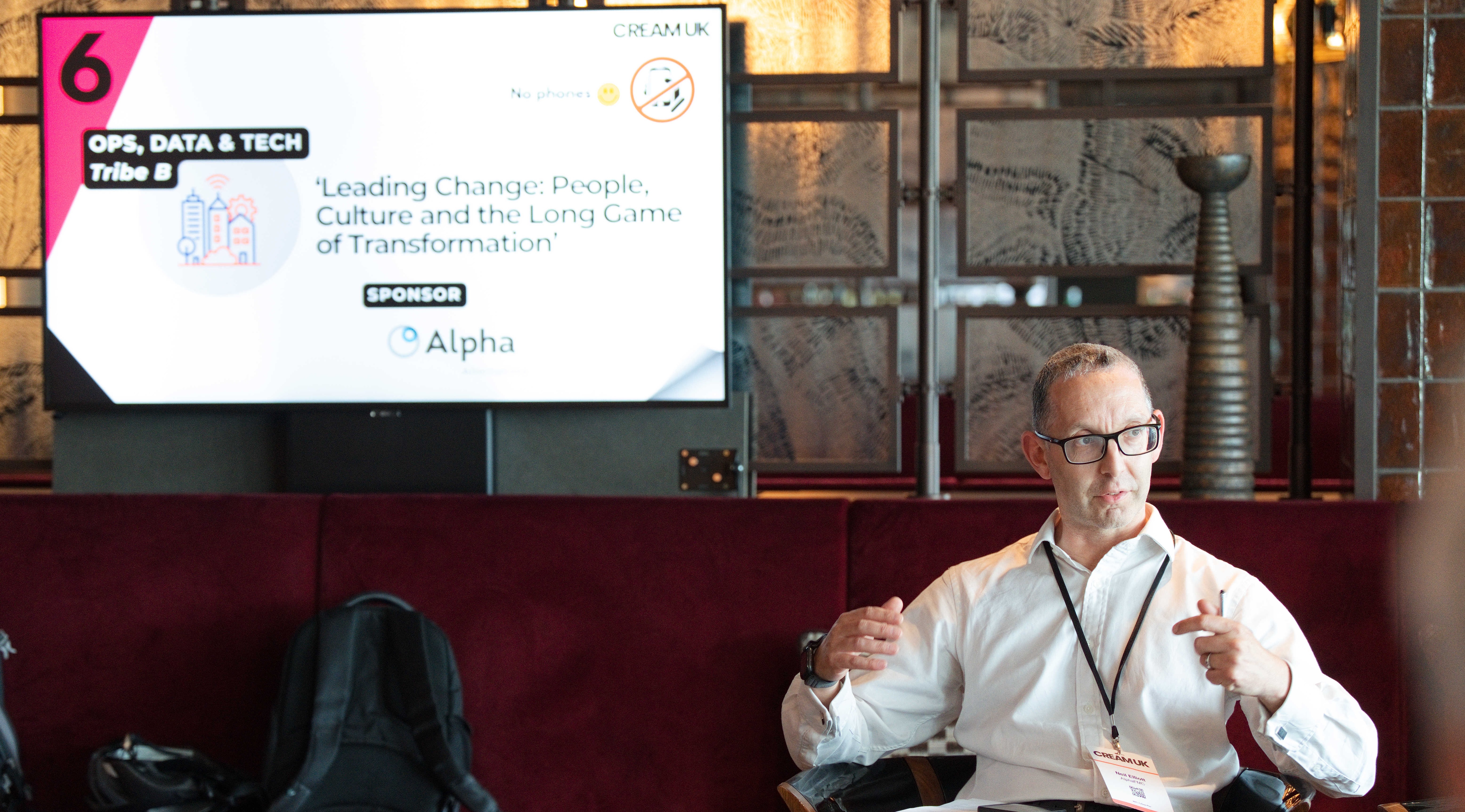
Tribe Host: Neil Elliott (Alpha FMC) [Pictured]

Co-Hosts: Katerina Pattison (Invesco), Candice Lemaitre (Places for London), Sarah Moulton (Argyll), Chris Boultwood (Workspace) and Jack Sibley (The King's Cross Group)
Big Themes
Change Management Is the Real Project, Not the Technology
The same pattern emerged repeatedly: businesses frame major shifts - outsourcing fund accounting, replacing an ERP, adopting AI tools - as "tech projects," which strips out the budget and attention that change management actually needs. One Co-Host described flagging this on a live transformation, warning that the way an organisation works today will look very different in six months' time - a message the business had not yet absorbed.
Leadership Sponsorship: Top-Down, Bottom-Up or Middle-Out
The Tribe debated how change gets legitimised. Some rely on visible CEO-level sponsorship; others found a "middle-out" approach more effective, building enthusiasm across senior leadership without making any one person the public face. The consensus was that sponsorship which never reaches the operational layer leaves middle management guessing at what leadership actually wants.
Problem-Led, Not Solution-Led, Adoption
The group pushed back on buying technology before requirements are understood - organisations should be problem-led, not solution-led. Consultancy contributors noted they have walked away from projects where clients wanted to skip requirements gathering entirely.
Data Trust and the Myth of a Single Source of Truth
Much of the conversation focused on why people default to downloading data into Excel rather than trusting central systems - a symptom of a system that does not serve its users, not a training problem. One member in the tribe argued that chasing a single universal source of truth is often unrealistic, given how differently the same figure, such as NIA or GIA, needs to be defined depending on the use case.
Democratising AI Through "Citizen Developers"
Organisations are letting motivated employees build lightweight AI tools, with guardrails around cost, data access and scale-up. The Tribe framed this as a way to surface genuine use cases from the ground up, while acknowledging the governance questions it raises - not least how to promote a successful pilot into an enterprise-grade tool without losing momentum.
AI Policy and Governance Sprawl
More than one Co-Host described setting out to write a single AI policy and ending up owning three - systems, personal data and AI - because AI now touches nearly every tool and workflow. The pace of change means annual review cycles are already too slow, and some are shortening them to six months.
Biggest Opportunity: Using AI to Solve the Adoption Problem It Creates
The clearest opportunity lies in using AI to solve the very change and adoption problem it often creates, rather than treating it purely as a technology decision. Examples from the Tribe included self-service, AI-driven training in place of dull live demos, using AI to speed up integrations so businesses can move towards best-of-breed systems rather than a single dominant platform, and empowering trained citizen developers to prototype close to the actual problem. The shared view was that AI is lowering the cost of experimentation far enough that the real advantage now lies in organisational agility and communication, not the technology itself.
Biggest Challenge: Landing the "Why" in the Operational Layer
The clearest challenge was translating leadership's ambition into something the operational layer understands, believes in and adopts. Co-Hosts from very different organisations described the same failure mode: leadership commits to a change, but the "why" never lands with the people expected to deliver it. This is compounded when teams are handed new technology as a fix for a process problem that was never properly diagnosed, or when change is imposed without early involvement - breeding resistance even among people who might otherwise be receptive.
CREAM UK took place on 23 June 2026 at Fulham Pier, London.
Find out more about the event at space-plus.org/cream-uk