.png)


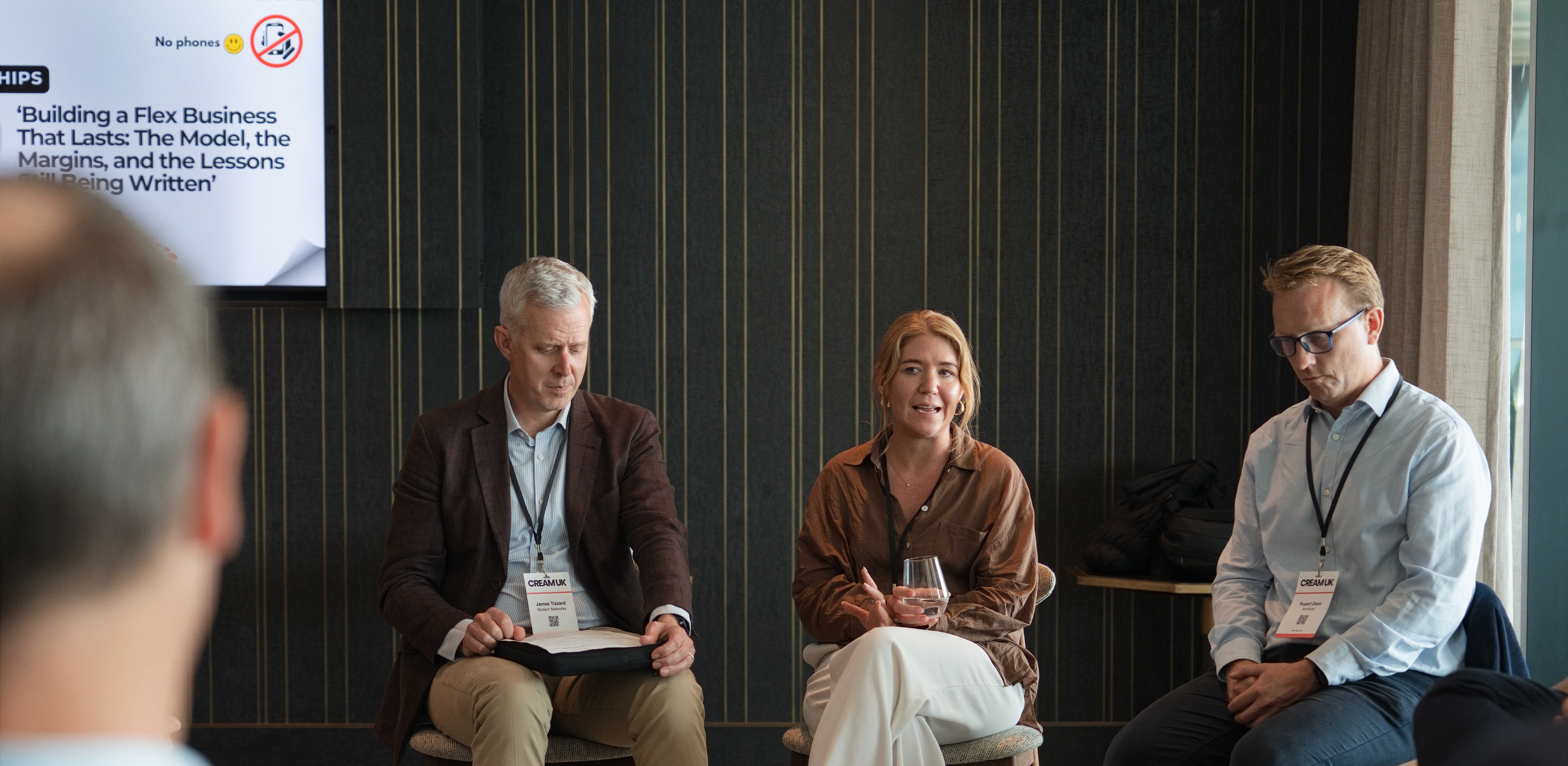
The flex sector has proven its demand; the open question is durability. The Flex & Partnerships Tribe at CREAM UK 2026 focused on operational resilience and differentiation in a market where the easy growth is behind it. Competition is fierce, smaller operators are disadvantaged, and macro forces are squeezing cost and demand at once. Yet the Tribe identified a clear route forward: operators who use technology and considered amenity to read and respond to occupier needs are best placed to retain customers and defend premium pricing.
Tribe Host: James Tizzard (Modern Networks)
Co-Hosts: Alan Pepper (Orega), Jonny Rosenblatt (Spacemade), Rupert Dean (xandwhy), Giles Fuchs (Office Space in Town) and Phuong Truong (WeWork)
Scribe: Gift Okolie (The Land Collective)
An Uneven Competitive Playing Field
Competition in the London office market is fierce, and the playing field is uneven. Smaller and mid-size flex operators face a structural disadvantage against dominant players, with larger landlords tending to gravitate towards established names rather than engaging meaningfully with independent operators. For operators outside the top tier, securing the right partnerships and stock is a challenge in itself, before the question of running the business profitably even arises.
Macro-Economic Pressure on Margins
Macro-economic pressures are compounding the difficulty. Energy prices, business rates and geopolitical instability are squeezing cost bases and occupier demand simultaneously, making margin management increasingly hard. When costs rise at the same time as demand softens, the room for error narrows, and operators are forced to manage both sides of the ledger with far greater precision.
Continuously Shifting Occupier Expectations
Occupier expectations are shifting continuously. Operators must stay ahead of demand on both pricing and product without overextending themselves - a balance that requires constant attention and a clear sense of which evolutions are worth funding and which are not.
Biggest Opportunity: Technology and Amenity as Retention Levers
The strongest opportunity lies in using technology and differentiated amenity as levers for retention and pricing power. Operators who invest in space optimisation and in distinct amenity offerings - private meeting rooms, wellness facilities, and sector-specific spaces - are best placed to improve retention and justify premium pricing. The Tribe singled out technology embedded within the space itself, used to identify and respond to emerging occupier trends, as an underused lever that forward-thinking operators are only beginning to exploit. Those who master it can stay ahead of demand rather than reacting to it, turning product intelligence into durable competitive advantage.
Biggest Challenge: Sustaining Margins Through Headwinds and Competition
The principal challenge is operating sustainably against a backdrop of macro headwinds and entrenched competition, while absorbing the cost of continuously evolving the product to meet changing occupier needs. Operators are caught between pressures they cannot control - energy costs, business rates, geopolitical uncertainty - and a market that rewards constant reinvention. Managing margins under these conditions, without overextending on product or losing ground to dominant incumbents, is the defining test of whether a flex business can endure rather than simply grow.
CREAM UK took place on 23 June 2026 at Fulham Pier, London.
Find out more about the event at space-plus.org/cream-uk