.png)


Beyond the Viability Gap: How the schemes that are getting built actually stack up

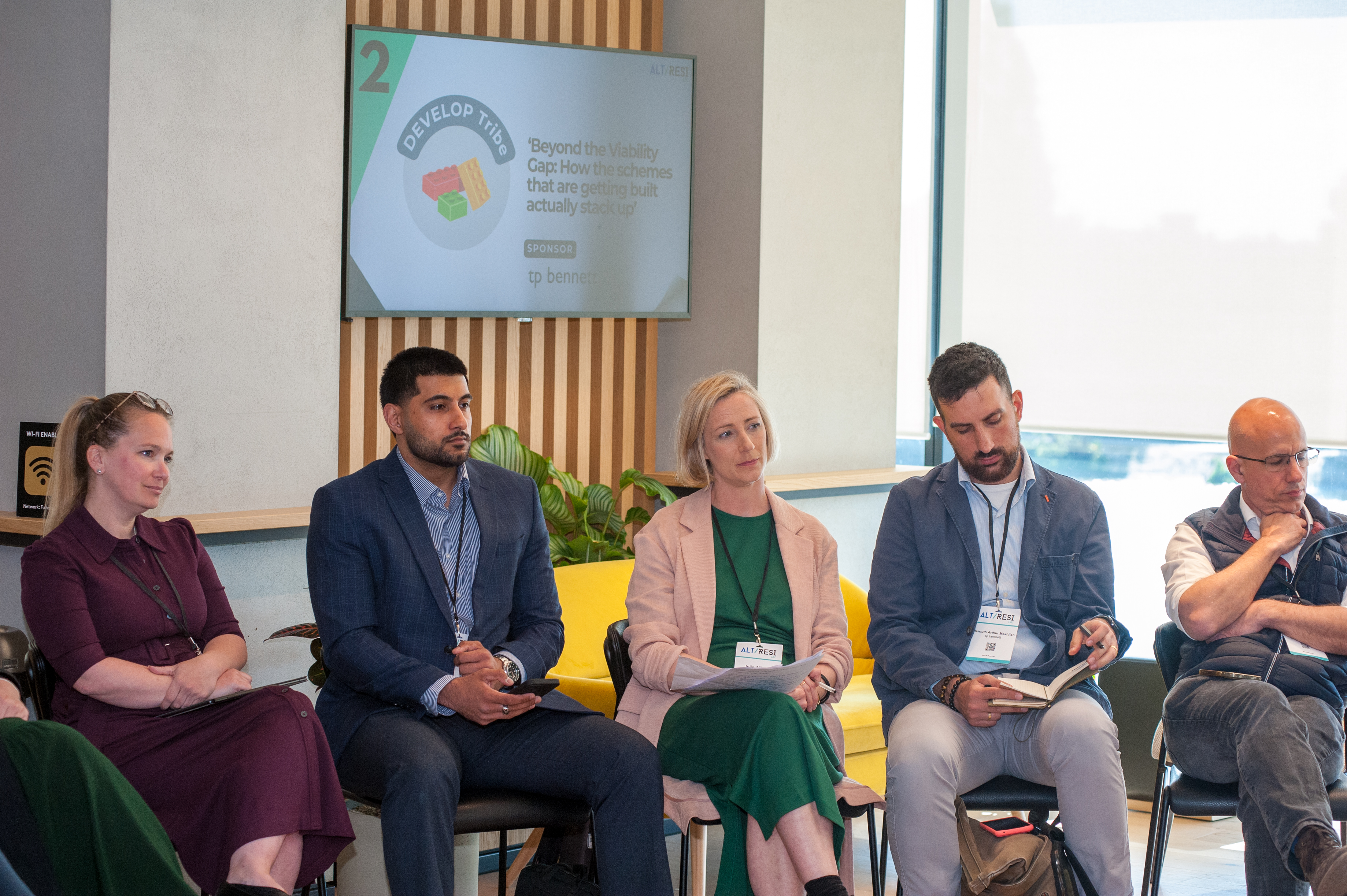
The UK development sector is in survival mode. At ALT/RESI UK, the DEVELOP Tribe gathered to unpack a viability crisis that shows no sign of easing - one where planning friction, rising costs, and macroeconomic instability have left traditional delivery models on shaky ground.
The conversation kept returning to one theme: de-risking. Whether through smarter partnerships, greater planning flexibility, or the ability to pivot across longer time horizons, developers are having to rethink how they get schemes off the ground. But the harder question is structural. Until policy acknowledges that profit is a legitimate return for risk - and starts incentivising demand rather than suppressing it - the industry will keep treading water despite genuine housing need.
Tribe Host: Julie Wilmer (tp bennett)
Co-Hosts: Bronwyn Jones (Greystar), Penny Cameron (Vastint), Tom Branton (Earls Court Development Company) and Paul Holcroft (Moda Living)
Summarised by: Edgar To.
Strategic Partnerships as Credibility Multipliers
While government grants directly impact the bottom line, the presence of a public-sector partner (such as a combined authority) serves a less tangible but equally critical role by providing "patient equity” and increased credibility to a project. This government-backed involvement fundamentally shifts the perception of risk for senior lenders in the debt market, making it easier for developers to secure traditional financing. Beyond finance, successful delivery requires stitching the developer into the local community and aligning the project with the specific internal narratives of local authorities, whether their priority is industrial strategy and innovation or heritage and culture.
Planning Flexibility for Long-Term Resilience
For major regeneration projects with 15- to 20-year horizons, the ability to adapt to changing market conditions is essential for survival. Developers are increasingly advocating for planning consents that allow buildings to pivot between uses, such as switching from commercial to residential, to respond to shifting demand. This flexibility is a vital defense mechanism against a punitive environment where a project that was viable at the initial planning stage may no longer stack up years later due to mid-cycle regulatory changes or economic shifts.
The Gateway Bottleneck and Regulatory Siloism
The implementation of the Building Safety Act and its Gateway process has introduced significant new risks, typically adding six to 12 months to project timelines and millions of pounds in technical design fees. A major point of friction is the “siloism" within regulatory bodies. Planners often continue to exert control over technical performance issues, such as overheating and fire safety, that are now strictly the remit of building control under the new regulations. This disconnect creates overlaying complexity, added costs, and significant uncertainty throughout the delivery process.
Re-Legitimising Profit as a Return for Risk
There is an urgent need for a mentality shift within the public sector to recognise that profit is a necessary return for risk, not a surplus or an optional extra. Without a guaranteed profit margin, global capital will simply bypass the UK in favor of more predictable international markets. When local authorities fail to grasp this fundamental economic driver, they inadvertently block development by setting financial hurdles that make projects inherently un-investable for the private sector.
A Shift Toward Demand-Side Economic Stimulus
While political focus is often on supply-side planning reform, the discussion suggests that the most effective big idea would be addressing the lack of purchasers and investors in the market. Punitive tax policies, including tax on tax and the lack of stamp duty relief for new builds, have stifled demand to the point where international investors find the UK environment baffling and too expensive. Without stimulus to encourage buyers, housing supply will continue to decline regardless of how many planning permissions are granted.
Biggest Opportunity: "Plug-and-Play" Regulatory-Cleared Assets
The most compelling opportunity lies in delivering Gateway 2-ready sites to a market that is hungry for certainty and speed. While the technical design phase is now more costly and time-consuming, a project that has already cleared its regulatory hurdles and has a fixed building design is highly attractive to institutional funds. By removing the risk of late-stage design fluctuations, developers can provide the "plug-and-play" certainty that modern investors prioritise above almost all other factors.
Biggest Challenge: Gateway 2 Uncertainty and Cash Flow Strain
The most significant hurdle is the unpredictability of the Gateway 2 process, which creates a massive financial burden that many smaller developers cannot afford to cash flow. Because the process is often subjective and takes far longer than the statutory 12-week period, it creates a high-risk gateway where developers must decide how much to spend on expensive technical designs (Stages 3 and 4) without any certainty of when, or if, they can break ground.
ALT/RESI UK took place on 28 April 2026 at Fulham Pier, London. Find out more about the event at space-plus.org/alt-resi-uk