


When the business demands evidence that workplace investment is delivering, how do real estate teams build an argument for workplace value that holds up to scrutiny?
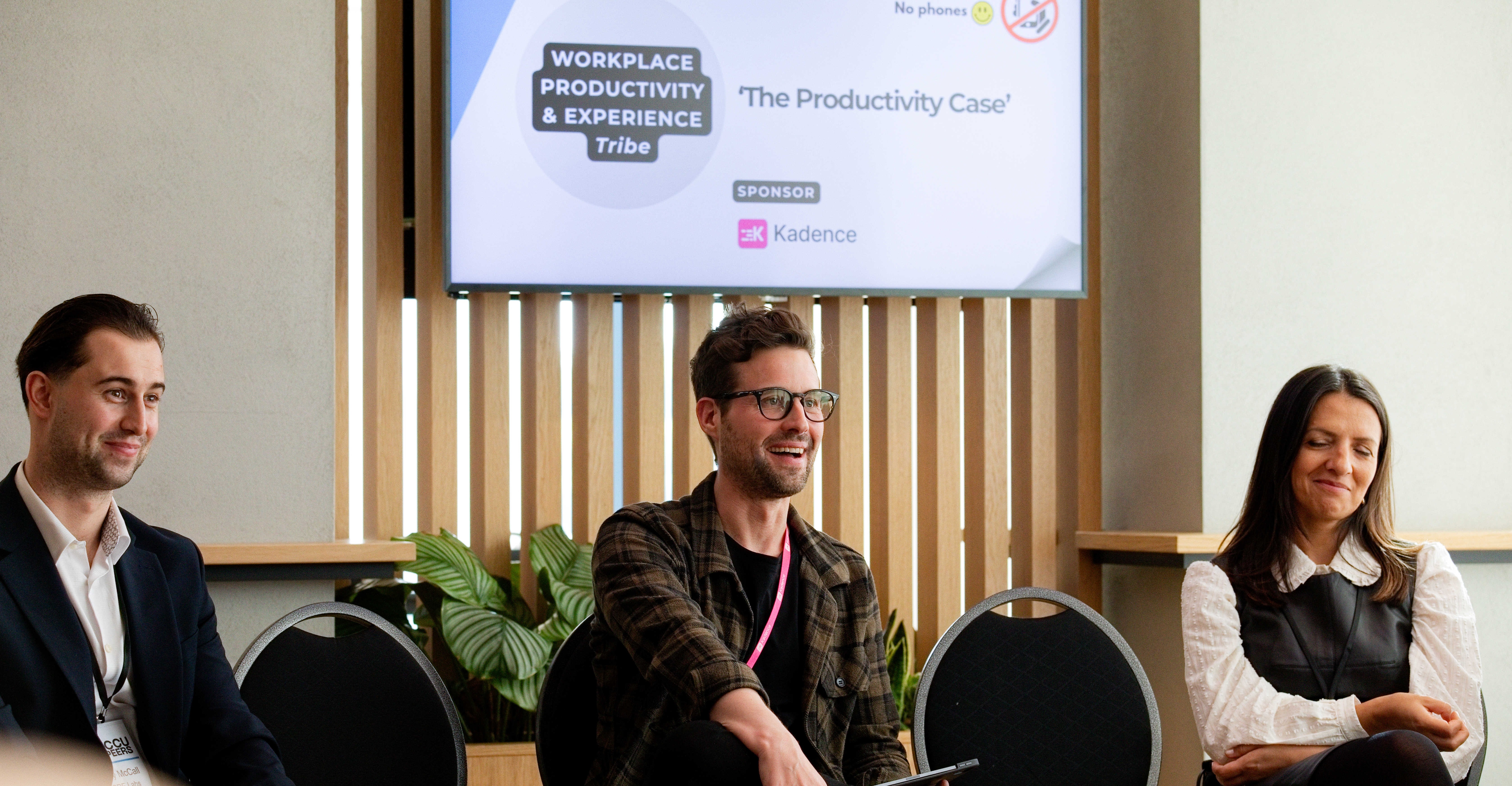
The Productivity Case, hosted by Dave Cairns of Kadence, examined how that argument is built when productivity has no agreed definition. The Tribe also covered AI, human connection and trust, and leadership alignment.
Tribe Host: Dave Cairns

Co-Hosts: Simon Francis (LifeArc), Chloe Baum (LinkedIn), Russell Wood (Travers Smith), Penny Tonks (Cognizant), Rebecca Milne (Haleon), James Stratford (AXA AL)
Scribe: Shakira Ahmed
Redefining Productivity and Demonstrating Workplace Value
The Tribe largely moved away from measuring productivity by office attendance, space utilisation or cost per square metre, and towards business outcomes, employee experience, collaboration and innovation. The definition varies by organisation, function and individual, and has to evolve with business priorities.
Host Dave Cairns noted that AI is increasingly shaping the productivity narrative, with efficiency gains attributed to automation and reduced headcount in the office. One of the Tribe members challenged the expectation that real estate teams should demonstrate workplace value on their own, arguing that business leaders must first define what they expect their spaces to achieve.
Another member explained that on revenue-generating client sites, productivity is measured through project delivery, timelines, budgets and commercial margins. Many of the Tribe also discussed moving from cost per square metre to output per square metre, to show real estate’s contribution to business performance.
The Tribe largely agreed that productivity is not a universal measure, and that each organisation has to define it against its own priorities.
AI Is Changing Productivity and Future Workplace Requirements
AI is reshaping how organisations operate, with productivity gains increasingly attributed to automation and workforce transformation. Many of the Tribe questioned whether reduced headcount and time savings necessarily mean improved productivity, particularly as the benefits are not measured consistently across organisations. The effect on physical workplaces is also uncertain.
One of the Tribe members described LinkedIn’s pilot “relationship workplace”, which explores AI-enabled environments, including meeting rooms integrated with AI agents, to support changing working behaviours. Another highlighted how hard it is to make long-term real estate decisions when future workforce structures and space requirements are increasingly unpredictable.
Many of the Tribe saw AI as an opportunity to rethink workplace design and efficiency. They believed organisations need flexible real estate strategies that respond to technological change and ensure productivity gains translate into business outcomes.
Human Connection and Trust as Drivers of Workplace Value
Human connection, trust and psychological safety were central to the discussion of productive workplace experiences. Many of the Tribe emphasised that physical workplaces offer spontaneous interactions, knowledge sharing, mentoring and collaborative problem-solving, all of which build relationships and drive innovation.
Google’s Project Aristotle was referenced to illustrate the role of psychological safety in helping employees share ideas, challenge perspectives and learn from mistakes. Some members of the Tribe also acknowledged that digital environments offer other ways to connect and contribute, and that working styles influence how relationships form.
The Host reinforced the importance of purposeful face-to-face interaction in building trust, noting that the level of connection required varies between individuals and teams. The Tribe largely agreed that the value of the physical workplace extends beyond individual productivity: connection and trust support collaboration, creativity and long-term organisational performance.
Leadership Alignment and Communication as Enablers of Productivity
Workplace strategy has to reflect organisational priorities. One of the Tribe members, supported by others, noted that different stakeholders may define productivity through cost efficiency, employee wellbeing or business performance.
Many of the Tribe also identified fragmented communication across Teams, WhatsApp and email as a barrier to efficiency, and called for clearer communication expectations and more consideration of individual working preferences. Productivity priorities keep changing with business performance, talent retention and organisational transformation, so workplace strategies need to stay flexible and adaptable.
The Tribe largely agreed that productivity is a shared organisational responsibility rather than solely a real estate challenge, and that it needs C-suite alignment, consistent communication practices and a clear understanding of business objectives.
Biggest Opportunity: Purposeful Workplace Experiences and Better Performance Measures
Many of the Tribe saw an opportunity to move from encouraging office attendance to giving employees purposeful reasons to come together. Examples included laptop-free collaboration sessions, cross-functional knowledge sharing and dedicated time for mentoring and problem solving. Designing workplace experiences around specific outcomes can strengthen collaboration, innovation and engagement while demonstrating the value of physical space.
The second opportunity is to move beyond occupancy and cost per square metre towards measures that capture collaboration, innovation, employee experience and business outcomes. That would let real estate teams show their strategic contribution and build a stronger business case for workplace investment.
Biggest Challenge: Measuring Value and Planning for Rapid Change
Many of the Tribe repeatedly questioned how productivity should be defined and measured, particularly when output depends on many factors, including AI, individual working preferences, leadership and organisational culture. Traditional real estate metrics do not capture innovation, trust, psychological safety or the long-term benefits of collaboration, which makes workplace ROI hard to demonstrate consistently.
Planning is complicated further by AI transformation, hybrid working, uncertain headcount, generational preferences and competing leadership priorities. Real estate decisions involve long-term commitments, while organisational priorities and working behaviours can change much faster. Workplace teams are often expected to address cultural and behavioural challenges beyond their direct control.
OCCUPEERS took place on 13 October 2026 at Fulham Pier, London.
Find out more about the event at space-plus.org/occupeers