


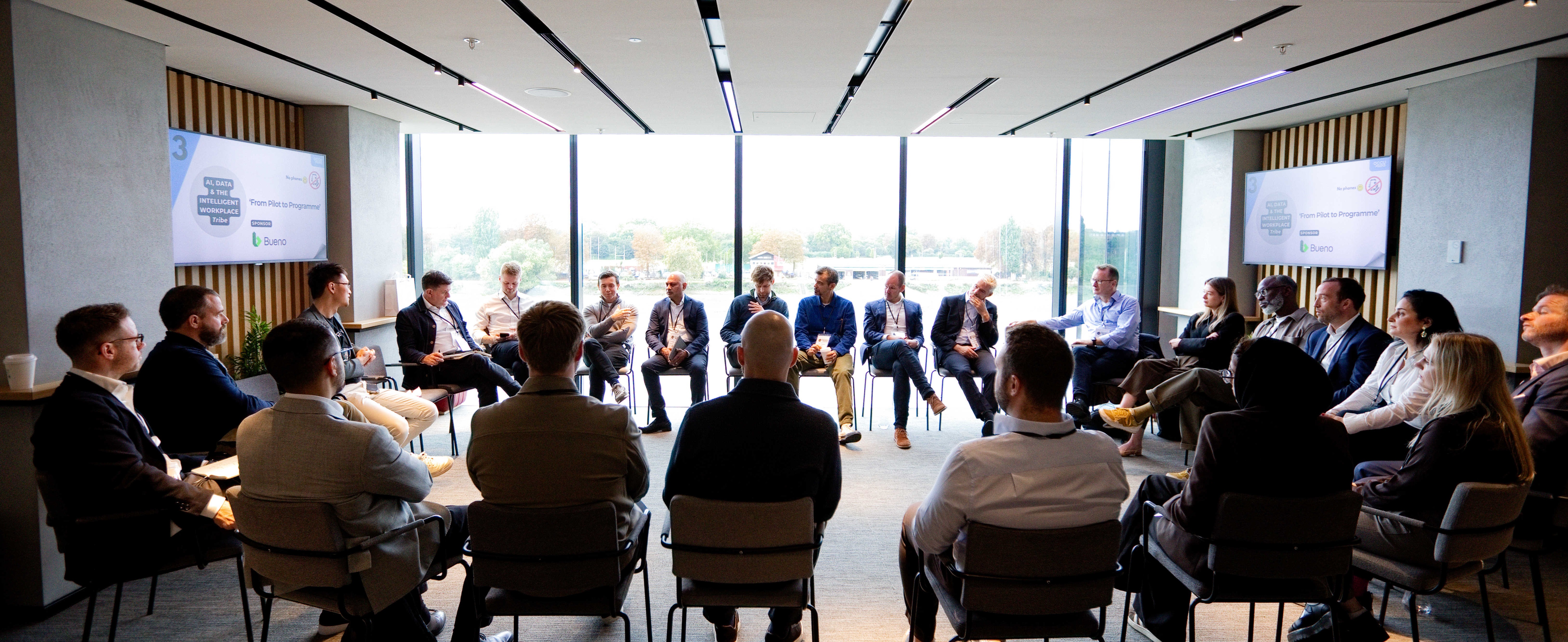
Many AI initiatives stall before they scale. What blocks the move from pilot to full implementation, and what has helped move things forward?
From Pilot to Programme, hosted by Haibo Chen of Bueno, examined why so many AI initiatives stall. The Tribe covered data collection and governance, security and compliance, business objectives, organisational adoption and long-term planning.
Tribe Host: Haibo Chen

Co-Hosts: Alex Grossick (Deutsche Bank), Martin Silvester (A&O Shearman), Toby Chapman (WSP), Surasen Naidu (Standard Chartered) and Mel Reeves (The Crown Estate)
Scribe: Shakira Ahmed
Data Quality and Governance Come First
In the Tribe it was suggested that pilots tend to run on high-quality data, whereas data across the wider organisation is often inaccurate and inconsistent. This undermines the reliability of results at scale. Many of the Tribe members were concerned that AI can produce convincing outputs from poor-quality data, so that errors go unnoticed.
Many of the Tribe favoured regular data review and cleaning, clear data governance policies and dedicated teams responsible for data quality. The Tribe largely agreed that reliable data and strong governance need to be in place from the start. Adopting AI quickly achieves little if the data underneath it cannot be trusted.
Security, Compliance and Internal Barriers
A technically successful pilot can still struggle to pass the internal processes required for company-wide adoption. Many of the Tribe questioned whether security and compliance teams should be involved at the start of a pilot rather than only at the point of standard deployment, with clear policies and governance requirements set from the outset.
Some Tribe members noted that projects often lose momentum at the handover to risk, compliance and security teams, particularly in financial services. Most of the Tribe saw closer collaboration between departments, and a shared understanding of the technology, as the way to keep progress moving.
Clear Business Objectives Before the Pilot
A question that kept returning was whether organisations are using AI to solve real business problems or because they feel pressure to adopt emerging technology. One member of the Tribe challenged the use of usage targets as a measure of success, arguing that using Copilot to draft emails does not amount to organisational transformation.
Many of the Tribe believed the problem AI is meant to solve should be defined before a pilot starts, and that the initiative should align with wider business objectives. One example showed the cost of skipping that step: an AI tool tested for workplace space planning took longer than a person to complete the task and cost almost twice as much.
Encouraging Adoption Across the Organisation
Many of the Tribe identified resistance to change as a significant barrier, particularly among experienced professionals who question the accuracy of AI or fear it could eventually replace their roles. Adoption depends on workplace culture and on employees understanding the benefits, as much as on the technology itself.
One member of the Tribe described creating a small internal team of employees open to change, which demonstrated early successes and gradually encouraged wider take-up. Strong internal champions were seen as essential for overcoming resistance, building confidence and maintaining momentum. There was broad agreement that this takes effective change management, clear communication, employee education and shared objectives.
Planning for the Long Term
Some Tribes members believe that many organisations lack dedicated technology teams, which limits the knowledge and resources available for implementation. The move from pilot to programme can also take longer than expected.
One member of the Tribe, speaking from the vendor side, described the process as a partnership lasting 12 to 18 months rather than a short-term project. The Tribe largely agreed that clear ownership, dedicated resources and planning that extends beyond the initial pilot are the conditions for AI initiatives to develop into programmes.
Biggest Opportunity: Early Successes and Internal Skills
Many of the Tribe believed small-scale projects can build confidence in AI across an organisation. A small team willing to embrace change can demonstrate the benefits before wider participation is sought, which addresses employee scepticism and builds support gradually.
The second opportunity is investment in dedicated technology and data expertise. Many corporate real estate teams lack the specialist resources to manage these technologies effectively. Most of the Tribe held that training, dedicated teams and experienced champions would make them less reliant on individual employees and better prepared for long-term adoption.
Biggest Challenge: Pace of Change and Competing Pilots
Many of the Tribe observed that AI is developing faster than most organisations can implement it. Multiple internal approvals and integration with existing systems make implementation lengthy, so a solution risks becoming outdated or misaligned with business objectives before it is fully in place.
Pilots are also multiplying across departments without a coordinated strategy. Overlapping projects create confusion, compete for resources and make priorities hard to set. Without coordination, organisations risk investing in separate systems rather than building an integrated approach to AI.
OCCUPEERS took place on 13 October 2026 at Fulham Pier, London.
Find out more about the event at space-plus.org/occupeers